Dinosaur Man talks about Latest updates and news in the world of Paleontology. Dinosaur Man is an source for the latest news on Paleontology. https://www.facebook.com/iamDinosaurMan @iamDinosaurMan
Saturday, July 13, 2019
Friday, September 14, 2018
Evolution of Jurassic Marine Reptiles
The long-term ecology and evolution of marine reptiles in a Jurassic seaway
Marine reptiles flourished in the Mesozoic oceans, filling ecological roles today dominated by crocodylians, large fish, sharks and cetaceans. Many groups of these reptiles coexisted for over 50 million years (Myr), through major environmental changes. However, little is known about how the structure of their ecosystems or their ecologies changed over millions of years. We use the most common marine reptile fossils—teeth—to establish a quantitative system that assigns species to dietary guilds and then track the evolution of these guilds over the roughly 18-million-year history of a single seaway, the Jurassic Sub-Boreal Seaway of the United Kingdom. Groups did not significantly overlap in guild space, indicating that dietary niche partitioning enabled many species to live together. Although a highly diverse fauna was present throughout the history of the seaway, fish and squid eaters with piercing teeth declined over time while hard-object and large-prey specialists diversified, in concert with rising sea levels. High niche partitioning and spatial variation in dietary ecology related to sea depth also characterize modern marine tetrapod faunas, indicating a conserved ecological structure of the world’s oceans that has persisted for over 150 Myr.
Image credit: Nikolay Zverkov.
Ref & abstract credit :https://www.nature.com/articles/s41559-018-0656-6
Tuesday, March 20, 2018
Dinosaurs of Lost Landmass
Lost Landmass Of Appalachia
It was 90 million years ago there was two landmasses: Appalachia and Laramidia divided by a sea , later on they will become Utah and Alberta.
A lack of fossils from Appalachia (eastern North America) Made it the ‘lost landmass.’
In the Mesozoic Era (252 to 66 million years ago) Appalachia, named for the Appalachian Mountains, was an island land mass separated from Laramidia to the west by the Western Interior Seaway. The seaway eventually shrank, divided across the Dakotas, and retreated towards the Gulf of Mexico and the Hudson Bay. This left the island masses joined in the continent of North America as the Rocky Mountains rose.
The Cenomanian to Maastrichtian of the Late Cretaceous saw the flooding of the interior of North America by the Western Interior Seaway, which created the eastern landmass of Appalachia and the western landmass of Laramidia. Though Appalachian dinosaur faunas are poorly known, they are nevertheless important for understanding Cretaceous dinosaur paleobiogeography and ecology.
The landmass of Appalachia harbored a diverse dinosaur fauna from the Aptian to the Maastrichtian stages of the Cretaceous. Data suggest that North American faunas of the Aptian were differentiated at the genus level to an extent, but a distinct east-west division was not present. At the family level, the biogeographic data compiled from Aptian North American dinosaur faunas suggest that even though genera were different across regions, the same clades were present across the continent. This Aptian North American fauna would therefore have included basal ornithomimosaurs, the carcharodontosaurid Acrocanthosaurus akotensis, dromaeosaurids (especially the taxon Deinonychus), nodosaurids, iguanodontians, basal neoceratopsian dinosaurs, possibly the orodromine dinosaur Zephyrosaurus, and titanosauriform sauropods. Albian-Cenomanian North American faunas include nodosaurids, dromaeosaurids, macronarian sauropods, carcharodontosaurids, and basal hadrosauroids. The absence of therizinosaurs and oviraptorosaurs from eastern North America during this time is considered ambiguous, as a large portion of the Arundel facies theropod material remains to be formally studied. During the Albian, orodromine dinosaurs are no longer found in Appalachian dinosaur faunas , though orodromines and other small ornithopod dinosaurs are known from all three western North American dinosaur faunas from the same time . Nevertheless, western and eastern faunas still share nodosaurids, iguanodontians, and titanosauriformes . The lack of faunal data from the Dakota Formation and Paluxy Formation may have caused the calculation of inflated values for their Simpson similarity index and Jaccard coefficient. Among the better-known western faunas, these values are all fairly high , suggesting relative faunal homogeneity in the western portion of North America.
Reference :
*http://palaeo-electronica.org/content/2018/2123-appalachia-biogeography
*Wikipedia articles #https://en.wikipedia.org/wiki/Appalachia_(Mesozoic)
*https://en.wikipedia.org/wiki/List_of_Appalachian_dinosaurs
Image credits :Wikimedia commons : Dmitry Bogdanov
It was 90 million years ago there was two landmasses: Appalachia and Laramidia divided by a sea , later on they will become Utah and Alberta.
A lack of fossils from Appalachia (eastern North America) Made it the ‘lost landmass.’
In the Mesozoic Era (252 to 66 million years ago) Appalachia, named for the Appalachian Mountains, was an island land mass separated from Laramidia to the west by the Western Interior Seaway. The seaway eventually shrank, divided across the Dakotas, and retreated towards the Gulf of Mexico and the Hudson Bay. This left the island masses joined in the continent of North America as the Rocky Mountains rose.
The Cenomanian to Maastrichtian of the Late Cretaceous saw the flooding of the interior of North America by the Western Interior Seaway, which created the eastern landmass of Appalachia and the western landmass of Laramidia. Though Appalachian dinosaur faunas are poorly known, they are nevertheless important for understanding Cretaceous dinosaur paleobiogeography and ecology.
Image : A typical Appalachian Dinosaur Acrocanthosaurus
The landmass of Appalachia harbored a diverse dinosaur fauna from the Aptian to the Maastrichtian stages of the Cretaceous. Data suggest that North American faunas of the Aptian were differentiated at the genus level to an extent, but a distinct east-west division was not present. At the family level, the biogeographic data compiled from Aptian North American dinosaur faunas suggest that even though genera were different across regions, the same clades were present across the continent. This Aptian North American fauna would therefore have included basal ornithomimosaurs, the carcharodontosaurid Acrocanthosaurus akotensis, dromaeosaurids (especially the taxon Deinonychus), nodosaurids, iguanodontians, basal neoceratopsian dinosaurs, possibly the orodromine dinosaur Zephyrosaurus, and titanosauriform sauropods. Albian-Cenomanian North American faunas include nodosaurids, dromaeosaurids, macronarian sauropods, carcharodontosaurids, and basal hadrosauroids. The absence of therizinosaurs and oviraptorosaurs from eastern North America during this time is considered ambiguous, as a large portion of the Arundel facies theropod material remains to be formally studied. During the Albian, orodromine dinosaurs are no longer found in Appalachian dinosaur faunas , though orodromines and other small ornithopod dinosaurs are known from all three western North American dinosaur faunas from the same time . Nevertheless, western and eastern faunas still share nodosaurids, iguanodontians, and titanosauriformes . The lack of faunal data from the Dakota Formation and Paluxy Formation may have caused the calculation of inflated values for their Simpson similarity index and Jaccard coefficient. Among the better-known western faunas, these values are all fairly high , suggesting relative faunal homogeneity in the western portion of North America.
Appalachian dinosaurs
| Acrocanthosaurus | Cretaceous | carnivore | - Large carnivorous carcharodontosaurid found in Maryland. |
| Ammosaurus | Jurassic | herbivore | - Small herbivorous sauropodomorph found in Connecticut. |
| Anchisaurus | Jurassic | herbivore | - Small herbivorous sauropodomorph found in Connecticut. |
| Appalachiosaurus | Cretaceous | carnivore | - Large tyrannosauroid from Alabama. |
| Arkansaurus | Cretaceous | carnivore | -An indeterminate theropod from Arkansas. Many paleontologists believe it could be related to Ornithomimus. |
| Astrodon | Cretaceous | herbivore | - Large herbivorous sauropod found in Maryland. |
| Claosaurus | Cretaceous | herbivore | - A primitive hadrosaur. The only known fossil specimen found got washed into the Western Interior Seaway. It is believed to be from Appalachia because it was found closer to the Appalachia side of the sea and is unknown from Laramidia. |
| Coelosaurus | Cretaceous | carnivore/omnivore | - May be synonymous with Ornithomimus. |
| Deinonychus | Cretaceous | carnivore | - A medium-sized raptor found in Maryland. |
| Diplotomodon | Cretaceous | carnivore | - A dubious name for a species of tyrannosauroid from New Jersey, possibly for Dryptosaurus or a potentially new genus. |
| Dryptosaurus | Cretaceous | carnivore | - Medium-sized tyrannosauriod from New Jeresy. |
| Eotrachodon | Cretaceous | herbivore | - A hadrosaur from Alabama known from a nearly complete skeleton. |
| Hadrosaurus | Cretaceous | herbivore | - First known dinosaur skeleton from the United States. Discovered in 1858 in Haddonfield, New Jersey. |
| Hypsibema | Cretaceous | herbivore | - Little known hadrosaur first discovered in North Carolina in 1869. Better material of a second species was found in Missouri. |
| Lophorhothon | Cretaceous | herbivore | - A hadrosaur from Alabama with skull fragments discovered. |
| Niobrarasaurus | Cretaceous | herbivore | - Another example of a nodosaurid dinosaur from Kansas. |
| Parrosaurus | Cretaceous | herbivore | - A junior synonym of Hypsibema missouriensis. It is the state dinosaur of Missouri. |
| Priconodon | Cretaceous | herbivore | - A nodosaur from Maryland found only from fossilized teeth. |
| Propanoplosaurus | Cretaceous | herbivore | - A nodosaurid dinosaur from Maryland. |
| Podokesaurus | Jurassic | carnivore | - Small therapod from Connecticut River Valley, may be synonymous with Coelophysis. |
| Silvisaurus | Cretaceous | herbivore | - A herbivorous nodosaur from the state of Kansas. Similarly to Claosaurus, This specimen found was probably washed into the Western Interior Seaway. It is believed to be from Appalachia because it was found closer to the Appalachia side of the sea. |
| Tenontosaurus | Cretaceous | herbivore | - A herbivorous iguanodontid whose fossil remains have been discovered in Maryland. |
| Zephyrosaurus | Cretaceous | herbivore | - A herbivorous hypsilophodontid whose fossil remains have been discovered in Maryland and Virginia. |
Reference :
*http://palaeo-electronica.org/content/2018/2123-appalachia-biogeography
*Wikipedia articles #https://en.wikipedia.org/wiki/Appalachia_(Mesozoic)
*https://en.wikipedia.org/wiki/List_of_Appalachian_dinosaurs
Image credits :Wikimedia commons : Dmitry Bogdanov
Saturday, February 24, 2018
Mansourasaurus shahinae - New Species of Titanosaur from Egypt
A New Titanosaur Species discovered in Egypt: Mansourasaurus shahinae.
Mansourasaurus shahinae, was a type of titanosaur-sauropod (long-necked plant-eating) dinosaurs which roamed Earth around 80 million years ago during Cretaceous period.
Prominent hypotheses advanced over the past two decades have sought to
characterize the Late Cretaceous continental vertebrate
palaeobiogeography of Gondwanan landmasses, but have proved difficult to
test because terrestrial vertebrates from the final ~30 million years
of the Mesozoic are extremely rare and fragmentary on continental Africa
(including the then-conjoined Arabian Peninsula but excluding the
island of Madagascar). Here we describe a new titanosaurian sauropod
dinosaur, Mansourasaurus shahinae gen. et sp. nov., from the
Upper Cretaceous (Campanian) Quseir Formation of the Dakhla Oasis of the
Egyptian Western Desert. Represented by an associated partial skeleton
that includes cranial elements, Mansourasaurus is the most
completely preserved land-living vertebrate from the post-Cenomanian
Cretaceous (~94–66 million years ago) of the African continent.
Phylogenetic analyses demonstrate that Mansourasaurus is nested
within a clade of penecontemporaneous titanosaurians from southern
Europe and eastern Asia, thereby providing the first unambiguous
evidence for a post-Cenomanian Cretaceous continental vertebrate clade
that inhabited both Africa and Europe. The close relationship of Mansourasaurus
to coeval Eurasian titanosaurians indicates that terrestrial vertebrate
dispersal occurred between Eurasia and northern Africa after the
tectonic separation of the latter from South America ~100 million years
ago. These findings counter hypotheses that dinosaur faunas of the
African mainland were completely isolated during the post-Cenomanian
Cretaceous.
Image credit: Andrew McAfee, Carnegie Museum of Natural History
Ref & abstract credit : https://www.nature.com/articles/s41559-017-0455-5
Caihong juji - newly discovered Jurassic theropod
The newly discovered Jurassic theropod Caihong juji, had a beautiful iridescent coloration .
This new theropod shows an array of bony features, as well as plumage characteristics and putative melanosome morphologies not previously seen in other Paraves, and thus further informs the pattern of character acquisition close to the origin of avian flight.
The Jurassic Yanliao theropods have offered rare glimpses of the early paravian evolution and particularly of bird origins, but, with the exception of the bizarre scansoriopterygids, they have shown similar skeletal and integumentary morphologies. Here we report a distinctive new Yanliao theropod species bearing prominent lacrimal crests, bony ornaments previously known from more basal theropods. It shows longer arm and leg feathers than Anchiornis and tail feathers with asymmetrical vanes forming a tail surface area even larger than that in Archaeopteryx. Nanostructures, interpreted as melanosomes, are morphologically similar to organized, platelet-shaped organelles that produce bright iridescent colours in extant birds. The new species indicates the presence of bony ornaments, feather colour and flight-related features consistent with proposed rapid character evolution and significant diversity in signalling and locomotor strategies near bird origins.
Image credit: Velizar Simeonovski, Field Museum.
Ref & abstract credit :https://www.nature.com/articles/s41467-017-02515-y
Saturday, February 18, 2017
Hatzegopteryx where top predators of Cretaceous Romania
A new study of neck biomechanics in Neck biomechanics indicate that giant Transylvanian azhdarchid pterosaurs were short-necked arch predators.
Azhdarchid pterosaurs include the largest animals to ever take to the skies with some species exceeding 10 metres in wingspan and 220 kg in mass. Associated skeletons show that azhdarchids were long-necked, long-jawed predators that combined a wing planform suited for soaring with limb adaptations indicative of quadrupedal terrestrial foraging. The postcranial proportions of the group have been regarded as uniform overall, irrespective of their overall size, notwithstanding suggestions that minor variation may have been present.
Like all azhdarchid pterosaurs, Hatzegopteryx was probably a terrestrially foraging generalist predator. It is significantly larger than any other terrestrial predator from Maastrichtian Europe; due to its large size in an environment otherwise dominated by island dwarf dinosaurs, with no large hypercarnivorous theropods in the region, it has been suggested that Hatzegopteryx played the role of an apex predator in the Haţeg Island ecosystem. The robust anatomy of Hatzegopteryx suggests that it may have tackled larger prey than other azhdarchids, including animals too large to swallow whole; similarly, some modern storks (particularly the marabou stork and the jabiru) are known to attack and kill large prey such as flamingoes, and occasionally children, with their beaks. Meanwhile, other giant azhdarchids like Arambourgiania would probably have instead fed on small prey (up to the size of a human), including hatchling or small dinosaurs and eggs. Another pterosaur, Thalassodromeus, has similarly been suggested to be raptorial.
Credit:
*https://peerj.com/articles/2908/
*en.wikipedia.com
*image - Mark Witton
Wednesday, September 28, 2016
Triassic Reptile Had ‘Third Eye’
ഒരു മുതലയുടെ അത്ര മാത്രം വലിപ്പം ഉണ്ടായിരുന്ന ഉരഗം ആണ് ട്രൈഒപ്റ്റിക്കസ് ,
പേര് സൂചിപ്പിക്കുന്ന പോലെ തന്നെ ഇവയുടെ തലയോട്ടിയിൽ കണ്ണ് കുഴിയോട്
സാമ്യം ഉള്ള ഒരു ദ്വാരം പാലിയെന്റോളോജിസ്റ്റുകൾ കണ്ടെത്തി .
Paleontologists have described a completely unexpected new species of reptile that lived 230 million years ago (Triassic period).
The ancient reptile has been given the official name Triopticus primus, which means ‘the first of three eyes.’
“From the Latin ‘tri’ (three) and ‘optic’ (vision) for the large opening in the skull roof, resembling a third eye socket. The specific name is from the Latin ‘primus’ (first),” the paleontologists explained.
കൂടുതൽ വായനക്ക്
http://www.cell.com/current-biology/abstract/S0960-9822(16)30860-0
Paleontologists have described a completely unexpected new species of reptile that lived 230 million years ago (Triassic period).
The ancient reptile has been given the official name Triopticus primus, which means ‘the first of three eyes.’
“From the Latin ‘tri’ (three) and ‘optic’ (vision) for the large opening in the skull roof, resembling a third eye socket. The specific name is from the Latin ‘primus’ (first),” the paleontologists explained.
കൂടുതൽ വായനക്ക്
http://www.cell.com/current-biology/abstract/S0960-9822(16)30860-0
Sunday, September 25, 2016
Psittacosaurus Used Camouflage, New findings
3D Camouflage in an Ornithischian Dinosaur
Countershading was one of the first proposed mechanisms of camouflage . A dark dorsum and light ventrum counteract the gradient created by illumination from above, obliterating cues to 3D shape . Because the optimal countershading varies strongly with light environment , pigmentation patterns give clues to an animal’s habitat. Indeed, comparative evidence from ungulates shows that interspecific variation in countershading matches predictions: in open habitats, where direct overhead sunshine dominates, a sharp dark-light color transition high up the body is evident; in closed habitats (e.g., under forest canopy), diffuse illumination dominates and a smoother dorsoventral gradation is found. We can apply this approach to extinct animals in which the preservation of fossil melanin allows reconstruction of coloration . Here we present a study of an exceptionally well-preserved specimen of Psittacosaurus sp. from the Chinese Jehol biota . This Psittacosaurus was countershaded with a light underbelly and tail, whereas the chest was more pigmented. Other patterns resemble disruptive camouflage, whereas the chin and jugal bosses on the face appear dark. We projected the color patterns onto an anatomically accurate life-size model in order to assess their function experimentally. The patterns are compared to the predicted optimal countershading from the measured radiance patterns generated on an identical uniform gray model in direct versus diffuse illumination. These studies suggest that Psittacosaurus sp. inhabited a closed habitat such as a forest with a relatively dense canopy.
- •Preserved pigments in the dinosaur Psittacosaurus suggest countershading camouflage
- •We predicted the optimal countershading camouflage for different light environments
- •The dinosaur’s patterns would have been cryptic in a forest, but not open, habitat
- •We can also infer that dinosaur predators used shape-from-shading cues to detect prey
Model of Psittacosaurus sp. based on skin and pigmentation patterns (specimen from the Senckenberg Museum, Germany). Image credit: Jakob Vinther et al.
Close examination of melanosomes preserved in the specimen of Psittacosaurus preserved with integument indicated that the animal was countershaded, likely due to preferring a habitat in dense forests with little light, much like many modern species of forest-dwelling deer and antelope; stripes and spots on the limbs may represent disruptive coloration. The specimen also had dense clusters of pigment on its shoulders, face (possibly for display), and cloaca (which may have had an antimicrobial function), as well as large patagia on its hind legs that connected to the base of the tail. Its large eyes indicate that it also likely had good vision, which would have been useful in finding food or avoiding predators. The authors were unable to determine which species of Jehol Formation Psittacosaurus the specimen belonged to due to the way the skull is preserved, but ruled out P. mongoliensis, based on hip features.
Credit:
*cell.com
*en.wikipedia.com
* Jakob Vinther et al. 2016. 3D Camouflage in an Ornithischian Dinosaur. Current Biology 26: 1-7; doi: 10.1016/j.cub.2016.06.065
Tuesday, July 12, 2016
Spinosaurus aegyptiacus
Spinosaurus (meaning "spine lizard") is a genus of theropod dinosaur that lived in what now is North Africa, during the lower Albian to lower Cenomanian stages of the Cretaceous period, about 112 to 97 million years ago. This genus was known first from Egyptian remains discovered in 1912 and described by German paleontologist Ernst Stromer in 1915. The original remains were destroyed in World War II, but additional material has come to light in recent years. It is unclear whether one or two species are represented in the fossils reported in the scientific literature. The best known species is S. aegyptiacus from Egypt, although a potential second species, S. maroccanus, has been recovered from Morocco.
Spinosaurus was among the largest of all known carnivorous dinosaurs, possibly larger than Tyrannosaurus and Giganotosaurus. Estimates published in 2005, 2007, and 2008 suggested that it was between 12.6–18 metres (41–59 ft) in length and 7 to 20.9 tonnes (7.7 to 23.0 short tons) in weight.[1][2][3] A new estimate published in 2014 and based on a more complete specimen, supported the earlier research, finding that Spinosaurus could reach lengths greater than 15 m (49 ft).[4] The skull of Spinosaurus was long and narrow, similar to that of a modern crocodilian. Spinosaurus is known to have eaten fish, and most scientists believe that it hunted both terrestrial and aquatic prey; evidence suggests that it lived both on land and in water as a modern crocodilian does. The distinctive spines of Spinosaurus, which were long extensions of the vertebrae, grew to at least 1.65 meters (5.4 ft) long and were likely to have had skin connecting them, forming a sail-like structure, although some authors have suggested that the spines were covered in fat and formed a hump. Multiple functions have been put forward for this structure, including thermoregulation and display.
content credit en.wikipedia.
image credit : Durbed
Wednesday, December 16, 2015
Kunbarrasaurus ieversi
Kunbarrasaurus ieversi: New ankylosaurs Dinosaur Species Discovered.
The near-complete skeleton of the 100 million-year-old (Cretaceous period) beast, including most of the skull and mandible, along with postcranial material, was discovered in 1989 in the Allaru Mudstone on Marathon Station near Richmond, north-western Queensland, by Mr Ian Ievers.
Minmi is the only known genus of ankylosaurian dinosaur from Australia. Seven specimens are known, all from the Lower Cretaceous of Queensland. Only two of these have been described in any detail: the holotype specimen Minmi paravertebra from the Bungil Formation near Roma, and a near complete skeleton from the Allaru Mudstone on Marathon Station near Richmond, preliminarily referred to a possible new species of Minmi. The Marathon specimen represents one of the world’s most complete ankylosaurian skeletons and the best-preserved dinosaurian fossil from eastern Gondwana. Moreover, among ankylosaurians, its skull is one of only a few in which the majority of sutures have not been obliterated by dermal ossifications or surface remodelling. Recent preparation of the Marathon specimen has revealed new details of the palate and narial regions, permitting a comprehensive description and thus providing new insights cranial osteology of a basal ankylosaurian. The skull has also undergone computed tomography, digital segmentation and 3D computer visualisation enabling the reconstruction of its nasal cavity and endocranium. The airways of the Marathon specimen are more complicated than non-ankylosaurian dinosaurs but less so than derived ankylosaurians. The cranial (brain) endocast is superficially similar to those of other ankylosaurians but is strongly divergent in many important respects. The inner ear is extremely large and unlike that of any dinosaur yet known. Based on a high number of diagnostic differences between the skull of the Marathon specimen and other ankylosaurians, we consider it prudent to assign this specimen to a new genus and species of ankylosaurian. Kunbarrasaurus ieversi gen. et sp. nov. represents the second genus of ankylosaurian from Australia and is characterised by an unusual melange of both primitive and derived characters, shedding new light on the evolution of the ankylosaurian skull.
REF :Leahey L.G. et al. 2015. Cranial osteology of the ankylosaurian dinosaur formerly known as Minmi sp. (Ornithischia: Thyreophora) from the Lower Cretaceous Allaru Mudstone of Richmond, Queensland, Australia. PeerJ 3: e1475; doi: 10.7717/peerj.1475
mage credit: © Australian Geographic.
Tuesday, October 6, 2015
ദിനോസറുകളുടെ വംശനാശം
തുടക്ക ജുറാസ്സിക് കാലം തൊട്ടു് അന്ത്യ ക്രിറ്റേഷ്യസ് വരെ ഭൂമിയിൽ ഏറ്റവും പ്രാതിനിധ്യമുള്ള ജീവിയും ദിനോസറുകളായിരുന്നു. എന്നാൽ, അന്ത്യ ക്രിറ്റേഷ്യസ് കാലത്ത് സംഭവിച്ച, ഭൂമിയുടെ ചരിത്രം കണ്ട ഒരു വലിയ വംശനാശത്തിൽ (കേ-ടി വംശനാശം) അന്ന് ജീവിച്ചിരുന്ന മിക്ക ദിനോസർ വർഗ്ഗങ്ങളും നശിച്ചു. ഉൽക്ക പതിച്ചതു കൊണ്ട് മാത്രം അല്ല പരിണിത ഫലമായി ഇന്ത്യയിലെ ഡെക്കാനിൽ ഉണ്ടായ അഗ്നിപർവതസ്ഫോടനങ്ങളുടെ കൂടെ ഫലമാണ് ഡൈനസോറുകളുടെ നാശത്തിനു കാരണമായ കേ-ടി വംശനാശം എന്ന് പുതിയ പഠന റിപ്പോർട്ടുക്കൾ സൂചിപ്പിക്കുന്നു.
ഇവ നാമാവശേഷമായതിനെക്കുറിച്ചു പല സിദ്ധാന്തങ്ങളും നിലവിലുണ്ട് - ഉൽക്കകൾ പതിച്ചതുകൊണ്ടോ അഗ്നിപർവതസ്ഫോടനത്താലോ ഭൂമിയിലുണ്ടായ മാറ്റങ്ങളാണു ഡൈനസോറുകളുടെ നാശത്തിനു കാരണമെന്നാണു കരുതപ്പെടുന്നത്.
ക്രിറ്റേഷ്യസ് കാലഘട്ടം
ഭുമിയുടെ ചരിത്രം കണ്ട ഒരു വലിയ വംശനാശമാണ് ക്രിറ്റേഷ്യസ് കാലഘട്ടം സാക്ഷ്യം വഹിച്ചത്. ഇതിനെ കേ - ടി വംശനാശം എന്ന് വിളിക്കുന്നു. ഇത് കേവലം ദിനോസറുകളെ മാത്രം അല്ല ബാധിച്ചത്, ഈ കാലയളവിൽ ജീവിച്ചിരുന്ന എഴുപത്തഞ്ച് ശതമാനം ജീവികളും ഈ വംശനാശത്തിൽ നശിച്ചുപോയി ഇതിൽ കരയിൽ ഉണ്ടായിരുന്ന പറക്കാത്ത ഇനത്തിൽ പെട്ട എല്ലാ ദിനോസറുകളും , കടലിൽ വസിച്ചിരുന്ന വലിയ ഉരഗങ്ങൾ , പറക്കുന്ന ഉരഗങ്ങൾ എന്നിവയെല്ലാം പെടും.എന്നാൽ ഈ വംശനാശം പെട്ടന്ന് ഉള്ള ഒന്നായിരുന്നില്ല മറിച്ച് ആയിരകണക്കിന് വർഷങ്ങൾ കൊണ്ടാണ് ഇത് സംഭവിച്ചത് .
An international team of scientists from India and the United States has uncovered evidencein 2015 that a massive comet or asteroid impact on Earth 66 million years ago accelerated the eruptions of volcanoes in what is now the Deccan Traps of India for thousands of years, and that together these two catastrophes wiped out the dinosaurs and many other groups of organisms.
The new measurements of Deccan volcanic activity indicate a dramatic increase in the rate of eruption of the volcanoes within 50,000 years of the Chicxulub impact.
Collide impact and flood volcanism compete as leading candidates for the cause of terminal-Cretaceous mass extinctions. High-precision 40Ar/39Ar data indicate that these two mechanisms may be genetically related, and neither can be considered in isolation. The existing Deccan Traps magmatic system underwent a state shift approximately coincident with the Chicxulub impact and the terminal-Cretaceous mass extinctions, after which ~70% of the Traps' total volume was extruded in more massive and more episodic eruptions. Initiation of this new regime occurred within ~50,000 years of the impact, which is consistent with transient effects of impact-induced seismic energy. Post-extinction recovery of marine ecosystems was probably suppressed until after the accelerated volcanism waned.
Massive eruptions formed the Deccan Traps flood basalts in India at around the same time as the mass extinction event 65 million years ago. Renne et al. precisely dated the massive volcanic field, which suggests a simultaneous increase in volcanism associated with the famous Chicxulub impact. Strong ecologic recovery may have been impossible until the volcanism slowed down 500,000 years later.
Saturday, August 1, 2015
ജുറാസിക് കാലഘട്ടത്തിലെ ഈന്ത് ചെടികള് ഇന്ത്യയിൽ കണ്ടെത്തി
ജുറാസിക് കാലഘട്ടത്തില് ഭൂമിയിലുണ്ടായിരുന്ന ഈന്ത്
വര്ഗത്തില്പ്പെട്ട രണ്ട് ചെടികളെ ഗവേഷകര് ഒഡിഷയില് കണ്ടെത്തി.
ജീവിക്കുന്ന ഫോസില് എന്നാണ് സൈക്കാസ് (ഈന്ത്) കുടുംബത്തിലെ ചെടികള്
വിശേഷിപ്പിക്കപ്പെടുന്നത്.
സൈക്കാസ് ഒറിക്സന്സിസ്, സൈക്കാസ് നയാഗാര്ഹന്സിസ് എന്നിങ്ങനെയാണ് കണ്ടെത്തിയ ചെടികളുടെ ശാസ്ത്രീയനാമം.
ഭൂമിയില് 20 കോടി വര്ഷങ്ങള്ക്ക് മുമ്പാണ് ദിനോസറുകള് അടക്കിവാണ ജുറാസിക് കാലഘട്ടം നിലനിന്നിരുന്നത്. നീണ്ട ഇലകളുള്ള സൈക്കാസ് വിഭാഗത്തിലെ ചെടികള് ഈ കാലഘട്ടത്തില് സുലഭമായിരുന്നു. ജുറാസിക് യുഗത്തില് നിലനിന്നിരുന്ന ചുരുക്കം സസ്യവര്ഗങ്ങളാണ് ഇന്ന് ഭൂമിയില് അവശേഷിക്കുന്നത്.
Indian scientists have discovered two new Cycads species of plants in Odisha which were dominant some 201 million to 145 million years ago, popularly known as the Jurassic period.
Cycads are considered to be an ancient group of seed plants which have crown of large compound leaves and a stout trunk. They are regarded as living fossils.
Cycas is the type genus and the only genus recognised in the family Cycadaceae.
The discovery of the two new species was published in July issue of Asian Journal of Conservation Biology.
IANS
സൈക്കാസ് ഒറിക്സന്സിസ്, സൈക്കാസ് നയാഗാര്ഹന്സിസ് എന്നിങ്ങനെയാണ് കണ്ടെത്തിയ ചെടികളുടെ ശാസ്ത്രീയനാമം.
ഭൂമിയില് 20 കോടി വര്ഷങ്ങള്ക്ക് മുമ്പാണ് ദിനോസറുകള് അടക്കിവാണ ജുറാസിക് കാലഘട്ടം നിലനിന്നിരുന്നത്. നീണ്ട ഇലകളുള്ള സൈക്കാസ് വിഭാഗത്തിലെ ചെടികള് ഈ കാലഘട്ടത്തില് സുലഭമായിരുന്നു. ജുറാസിക് യുഗത്തില് നിലനിന്നിരുന്ന ചുരുക്കം സസ്യവര്ഗങ്ങളാണ് ഇന്ന് ഭൂമിയില് അവശേഷിക്കുന്നത്.
Indian scientists have discovered two new Cycads species of plants in Odisha which were dominant some 201 million to 145 million years ago, popularly known as the Jurassic period.
Cycads are considered to be an ancient group of seed plants which have crown of large compound leaves and a stout trunk. They are regarded as living fossils.
Cycas is the type genus and the only genus recognised in the family Cycadaceae.
The discovery of the two new species was published in July issue of Asian Journal of Conservation Biology.
IANS
Wednesday, July 29, 2015
തെറാപ്പോഡകളുടെ വിജയ രഹസ്യം
തെറാപ്പോഡ എന്ന് കേൾക്കുപ്പോ മനസ്സിൽ ആദ്യം ഓടിവരുന്ന ചിത്രം റ്റിറാനോസോറസ് റെക്സ് എന്ന ഭീകരന്റെ തന്നെ ആവും എന്തായിരുന്നു തെറാപ്പോഡകളുടെ വിജയ രഹസ്യം, എന്ത് കൊണ്ട് തെറാപ്പോഡകൾ ഇത്രക്ക് വിജയകരമായി ഭൂമിയിൽ വ്യാപിച്ചു . തെറാപ്പോഡ വിഭാഗത്തിൽ പെട്ട ദിനോസറുകൾ പൊതുവേ മാംസഭുക്കുകൾ ആയിരുന്നു ., ഇവയുടെ അറക്കവാളിന്റേതുപോലെ പല്ലുക്കൾ ആണ് ഈ വിജയത്തിന് പിന്നിൽ ഉള്ള രഹസ്യം എന്ന് പുതിയ പഠനങ്ങൾ തെളിയിക്കുന്നു.
Tooth morphology and development can provide valuable insights into the feeding behaviour and evolution of extinct organisms. The teeth of Theropoda, the only clade of predominantly predatory dinosaurs, are characterized by ziphodonty, the presence of serrations (denticles) on their cutting edges. Known today only in varanid lizards, ziphodonty is much more pervasive in the fossil record. Here we present the first model for the development of ziphodont teeth in theropods through histological, SEM, and SR-FTIR analyses, revealing that structures previously hypothesized to prevent tooth breakage instead first evolved to shape and maintain the characteristic denticles through the life of the tooth. We show that this novel complex of dental morphology and tissues characterizes Theropoda, with the exception of species with modified feeding behaviours, suggesting that these characters are important for facilitating the hypercarnivorous diet of most theropods. This adaptation may have played an important role in the initial radiation and subsequent success of theropods as terrestrial apex predators.
കുടുതൽ വായനക്ക്
https://en.wikipedia.org/wiki/Theropoda
https://ml.wikipedia.org/wiki/തെറാപ്പോഡ
http://www.nature.com/srep/2015/150728/srep12338/full/srep12338.html#introduction
കടപ്പാട്
* For images wiki commons
*For
Title:
|
Developmental and evolutionary novelty in the serrated teeth of theropod dinosaurs
|
Author:
|
K. S. Brink, R. R. Reisz, A. R. H. LeBlanc, R. S. Chang, Y. C. Lee, C. C. Chiang
|
Publication:
|
Scientific Reports
|
Publisher:
|
Nature Publishing Group
|
Date:
|
Jul 28, 2015
|
Sunday, July 26, 2015
ചിറക്കുക്കൾ ഉള്ള ദിനോസർ
Image credit: Chuang Zhao.
പക്ഷികളെ പോലെ ചിറക്കുക്കൾ ഉള്ള പുതിയ ദിനോസറിനെ കണ്ടെത്തി en:Zhenyuanlong suni.
ചിറക്കുകൾ ഉണ്ടെക്കിലും ഇവയ്ക്ക് പറക്കാൻ സാധ്യമല്ലായിരുന്നു എന്നാണ് അനുമാനം.
വെലോസിറാപ്റ്ററിനോടാണ് കൂടുതൽ സാമ്യം ഇവയ്ക്ക് . ഡ്രോമയിയോസോറിഡ് തേറാപോഡ് വിഭാഗത്തിൽപ്പെടുന്ന ഈയിനം ദിനോസറുകൾ ഏകദേശം 83 മുതൽ 70 ദശലക്ഷം വർഷങ്ങൾക്ക് മുമ്പ് അതായത് ക്രാറ്റേഷ്യസ് യുഗത്തിന്റെ ഉത്തരഘട്ടത്തിൽ ജീവിച്ചിരുന്നവയാണെന്ന് കണക്കാക്കപ്പെടുന്നു.
Zhenyuanlong (meaning "Zhenyuan's dragon", from Chinese Pinyin 龙 lóng "dragon") is a genus of dromaeosaurid dinosaur from the Yixian Formation of Liaoning, China. It lived during the Aptian age of the early Cretaceous period, approximately 125 million years ago. It is known from a single specimen belonging to the species Zhenyuanlong suni. This type specimen preserved a nearly complete skeleton that contains traces of feathers, including long tail feathers and large wings. In addition to further complicating diversity of Liaoning dromaeosaurids, this specimen provides the first evidence of well-developed pennaceous feathers in a large, non-flying dromaeosaur, raising the question of what function such wings would serve.
Monday, July 13, 2015
Brainfever bird (Hierococcyx varius)
പ്രാപിടിയൻ പക്ഷിയോട് ഏറെ സാമ്യമുള്ള ഇവയ്ക്ക് തകിട്ടുകലർന്ന ചാരനിറമാണ്. വേനൽ കാലമാകുമ്പോൾ എപ്പോഴും ബഹളം വച്ച് നടക്കുന്ന കുയിലാണിത്. രിറ്റി-രിറ്റി-രിറ്റി, പിപ്പീയാ-പിപ്പീയാ എന്നിങ്ങനെയാണ് പേക്കുയിലിന്റെ പാട്ട്. പിപ്പീയാ എന്നത് കിഴക്കേ വാ എന്നാണെന്നും ചിലർ പറയാറുണ്ട്. രാവും പകലും ശബ്ദമുണ്ടാക്കുന്നത് കൊണ്ടാവണം പേക്കുയിൽ എന്ന് വിളിയ്ക്കാൻ കാരണം. പൂത്താങ്കിരി, കരിയിലക്കിളി എന്നീ പക്ഷികളുടെ കൂടുകളിലാണ് പേക്കുയിൽ മുട്ടയിടുന്നത്. പേക്കുയിലിന്റെ കുഞ്ഞുങ്ങളുടെ നിറം മുതിർന്നവരുടേതിൽ നിന്ന് വ്യത്യസ്ഥമായിരിക്കും. ഷിക്രാക്കുയിൽ എന്നും ഇതിന് പേരുണ്ട്.
പേക്കുയിലിന്റെ പാട്ട്
Time: Night 11.00pm to 1.00am
Month: December
Location: Kozhikode.,Thottumukkam (part of western ghats)
Wednesday, June 10, 2015
പുതിയ തത്ത ചുണ്ടൻ ദിനോസർ
തത്തകളുടെ പോലെ ഉള്ള ചുണ്ടുകൾ ഉള്ള സെറാടോപിയ ദിനോസറിന്റെ പുതിയ ഉപവിഭാഗത്തെ കാനഡയിൽ കണ്ടെത്തി en:Regaliceratops peterhewsi.
സെറാടോപിയ അഥവാ സെറാടോപ്സിയാ
സസ്യഭോജികളായവയും, തത്തകളുടെ പോലെ ഉള്ള ചുണ്ടുകൾ ഉള്ളതുമായ ഒരു വിഭാഗം ദിനോസറുകൾ ആണ് സെറാടോപിയ അഥവാ സെറാടോപ്സിയാ . ഇവയുടെ ആദ്യം രൂപം വരുന്നത് ട്രയാസ്സിക് യുഗത്തിന്റെ അന്ത്യത്തിലാണ് (161 .0 ± 2.0 മയ). കൃറ്റേഷ്യസ് കാലത്തോടെ നോർത്ത് അമേരിക്ക , യൂറോപ്പ് ഏഷ്യ ഇവിടങ്ങളിൽ ഇവ പ്രധാനപെട്ട ഒരു ദിനോസർ വർഗ്ഗമായി മാറി എന്നാൽ 65 ദശ ലക്ഷം വർഷം മുൻപ്പ് ദിനോസറുകൾ വംശം അന്യം നിന്നു പോയ കേ-ടി വംശനാശം ഇവയ്ക്കും അന്ത്യം കുറിച്ചു.ദിനോസറുകളിൽ തലയോട്ടിയുടെ പ്രതേകത കൊണ്ട് എളുപ്പം തിരിച്ചറിയാവുന്ന ഒരു വിഭാഗം ആണ് ഇവ . ഫ്രിൽ എന്ന മുഖത്തിനു ചുറ്റും ഉള്ള അസ്ഥിയുടെ ആവരണവും പ്രതേകതയാണ് . വർഗ്ഗത്തിന്റെ മറ്റ് ഒരു ജീവി വർഗത്തിലും കാണാത്ത രോസ്ട്രൽ ബോൺ എന്ന പേരിൽ അറിയപെടുന്ന എല്ല് ഇവയ്ക്ക് ഉണ്ടായിരുന്നു, വായക്ക് ഇവയ്ക്കു തത്തമ്മയുടെ ചുണ്ടിന്റെ രൂപം നല്ക്കിയിരുന്നത് ഈ എല്ല് ആണ് .
a new genus and species of ceratopsid (horned dinosaur) that lived during the Cretaceous period, about 68 million years ago.
Whats interesting about it ?
- •A new horned dinosaur, Regaliceratops, is described based on a nearly complete skull
- •It exhibits large nasal and small postorbital horns, and large frill epiossifications
- •A derived chasmosaurine, the new animal shows centrosaurine-like display features
- •Evidence for evolutionary convergence in horned dinosaur display is documented
Regaliceratops is a genus of herbivorous ceratopsid dinosaur that lived during the late Cretaceous period, about 68 million years ago (Mya) in what is now Canada.
Closely related to Triceratops, Regaliceratops was named for its plated frill, which its describers thought looked somewhat like a crown. In 2005, geologist Peter Hews discovered a skull at the Oldman River in Alberta. The fossil was secured by a team of the Royal Tyrrell Museum. The specimen was given the nickname "Hellboy" for its horns and the difficulty of removing it from the matrix.
In 2015, Caleb Marshall Brown and Donald Henderson named and described the type species Regaliceratops peterhewsi. The generic name combines Latin regalis, "royal", a reference to both the crown-shaped neck shield and the "Royal" Tyrrell, with a Greek keras, "horn", and ops, "face". The specific name honours Hews.
The holotype, TMP 2005.055.0001, was found in a layer of the St. Mary River Formation dating from the middle Maastrichtian, about 68 million years old. It consists of a rather complete skull of which the snout bone, the rostral, is lacking. The skull has been deformed by compression and its rear and underside are obscured by matrix.
Regaliceratops was about five metres long, with an estimated weight of 1.5 tonnes.
Tuesday, March 31, 2015
Carnufex carolinensis
A new species of prehistoric crocodile that dates back 231
million years ago (Carnian stage of the Triassic period) has been
identified by a team of paleontologists led by Dr Lindsay Zanno of North
Carolina State University and the North Carolina Museum of Natural
Sciences.
This newly discovered crocodilian ancestor may have filled one of North America’s top predator roles before dinosaurs arrived on the continent. Carnufex carolinensis, or the “Carolina Butcher,” was a 9-foot long, land-dwelling crocodylomorph that walked on its hind legs and likely preyed upon smaller inhabitants of North Carolina ecosystems such as armored reptiles and early mammal relatives.
Triassic predatory guild evolution reflects a period of ecological flux spurred by the catastrophic end-Permian mass extinction and terminating with the global ecological dominance of dinosaurs in the early Jurassic. In responding to this dynamic ecospace, terrestrial predator diversity attained new levels, prompting unique trophic webs with a seeming overabundance of carnivorous taxa and the evolution of entirely new predatory clades. Key among these was Crocodylomorpha, the largest living reptiles and only one of two archosaurian lineages that survive to the present day. In contrast to their existing role as top, semi-aquatic predators, the earliest crocodylomorphs were generally small-bodied, terrestrial faunivores, occupying subsidiary (meso) predator roles. Here we describe Carnufex carolinensis a new, unexpectedly large-bodied taxon with a slender and ornamented skull from the Carnian Pekin Formation (~231 Ma), representing one of the oldest and earliest diverging crocodylomorphs described to date. Carnufex bridges a problematic gap in the early evolution of pseudosuchians by spanning key transitions in bauplan evolution and body mass near the origin of Crocodylomorpha. With a skull length of >50 cm, the new taxon documents a rare instance of crocodylomorphs ascending to top-tier predator roles in the equatorial regions of Pangea prior to the dominance of dinosaurs.
Reference:
“Early crocodylomorph increases top tier predator diversity during rise of dinosaurs”
DOI: 10.1038/srep09276
Authors: Lindsay Zanno, Susan Drymala, NC State University and the NC Museum of Natural Sciences; Vincent Schneider, NC Museum of Natural Sciences; Sterling Nesbitt, Virginia Polytechnic Institute
This newly discovered crocodilian ancestor may have filled one of North America’s top predator roles before dinosaurs arrived on the continent. Carnufex carolinensis, or the “Carolina Butcher,” was a 9-foot long, land-dwelling crocodylomorph that walked on its hind legs and likely preyed upon smaller inhabitants of North Carolina ecosystems such as armored reptiles and early mammal relatives.
Triassic predatory guild evolution reflects a period of ecological flux spurred by the catastrophic end-Permian mass extinction and terminating with the global ecological dominance of dinosaurs in the early Jurassic. In responding to this dynamic ecospace, terrestrial predator diversity attained new levels, prompting unique trophic webs with a seeming overabundance of carnivorous taxa and the evolution of entirely new predatory clades. Key among these was Crocodylomorpha, the largest living reptiles and only one of two archosaurian lineages that survive to the present day. In contrast to their existing role as top, semi-aquatic predators, the earliest crocodylomorphs were generally small-bodied, terrestrial faunivores, occupying subsidiary (meso) predator roles. Here we describe Carnufex carolinensis a new, unexpectedly large-bodied taxon with a slender and ornamented skull from the Carnian Pekin Formation (~231 Ma), representing one of the oldest and earliest diverging crocodylomorphs described to date. Carnufex bridges a problematic gap in the early evolution of pseudosuchians by spanning key transitions in bauplan evolution and body mass near the origin of Crocodylomorpha. With a skull length of >50 cm, the new taxon documents a rare instance of crocodylomorphs ascending to top-tier predator roles in the equatorial regions of Pangea prior to the dominance of dinosaurs.
Reference:
“Early crocodylomorph increases top tier predator diversity during rise of dinosaurs”
DOI: 10.1038/srep09276
Authors: Lindsay Zanno, Susan Drymala, NC State University and the NC Museum of Natural Sciences; Vincent Schneider, NC Museum of Natural Sciences; Sterling Nesbitt, Virginia Polytechnic Institute
Sunday, February 8, 2015
Qijianglong guokr
A team of paleontologists from Japan, China and Canada has described a new genus and species of sauropod dinosaur that lived during the Upper Jurassic epoch, approximately 160 million years ago.
The new dinosaur, named Qijianglong guokr (means Dragon of Qijiang), belongs to Mamenchisauridae, a family of dinosaurs known for their extremely long necks sometimes measuring up to half the length of their bodies.
The neck vertebrae and the head of the dinosaur were found near Qijiang, Chongqing Municipality, southern China.
“It is rare to find a head and neck of a long-necked dinosaur together because the head is so small and easily detached after the animal dies,” said Tetsuto Miyashita, a PhD student at the University of Alberta and a co-author of the paper published in the Journal of Vertebrate Paleontology.
Qijianglong guokr was about 15 meters in length. It had neck vertebrae that were filled with air, making the neck relatively lightweight despite its enormous size.
Interlocking joints between the vertebrae also indicate a surprisingly stiff neck that was much more mobile bending vertically than sideways, similar to a construction crane.
“Qijianglong guokr is a cool animal. If you imagine a big animal that is half-neck, you can see that evolution can do quite extraordinary things,” Miyashita said.
Mamenchisaurids are only found in Asia, but the discovery of Qijianglong guokr reveals that there could be as many differences among mamenchisaurids as there are between long-necked dinosaurs from different continents.
“Qijianglong guokr shows that long-necked dinosaurs diversified in unique ways in Asia during Jurassic times – something very special was going on in that continent. Nowhere else we can find dinosaurs with longer necks than those in China. The new dinosaur tells us that these extreme species thrived in isolation from the rest of the world,” Miyashita said.
“Mamenchisaurids evolved into many different forms when other long-necked dinosaurs went extinct in Asia. It is still a mystery why mamenchisaurids did not migrate to other continents.”
It is possible that the dinosaurs were once isolated as a result of a large barrier such as a sea, and lost in competition with invading species when the land connection was restored later.
The skeleton of Qijianglong guokr is now housed in a local museum in Qijiang.
Reference :
Lida Xing et al. A new sauropod dinosaur from the Late Jurassic of China and the diversity, distribution, and relationships of mamenchisaurids. Journal of Vertebrate Paleontology, published online: January 26, 2015; doi: 10.1080/02724634.2014.889701
The new dinosaur, named Qijianglong guokr (means Dragon of Qijiang), belongs to Mamenchisauridae, a family of dinosaurs known for their extremely long necks sometimes measuring up to half the length of their bodies.
The neck vertebrae and the head of the dinosaur were found near Qijiang, Chongqing Municipality, southern China.
“It is rare to find a head and neck of a long-necked dinosaur together because the head is so small and easily detached after the animal dies,” said Tetsuto Miyashita, a PhD student at the University of Alberta and a co-author of the paper published in the Journal of Vertebrate Paleontology.
Qijianglong guokr was about 15 meters in length. It had neck vertebrae that were filled with air, making the neck relatively lightweight despite its enormous size.
Interlocking joints between the vertebrae also indicate a surprisingly stiff neck that was much more mobile bending vertically than sideways, similar to a construction crane.
“Qijianglong guokr is a cool animal. If you imagine a big animal that is half-neck, you can see that evolution can do quite extraordinary things,” Miyashita said.
Mamenchisaurids are only found in Asia, but the discovery of Qijianglong guokr reveals that there could be as many differences among mamenchisaurids as there are between long-necked dinosaurs from different continents.
“Qijianglong guokr shows that long-necked dinosaurs diversified in unique ways in Asia during Jurassic times – something very special was going on in that continent. Nowhere else we can find dinosaurs with longer necks than those in China. The new dinosaur tells us that these extreme species thrived in isolation from the rest of the world,” Miyashita said.
“Mamenchisaurids evolved into many different forms when other long-necked dinosaurs went extinct in Asia. It is still a mystery why mamenchisaurids did not migrate to other continents.”
It is possible that the dinosaurs were once isolated as a result of a large barrier such as a sea, and lost in competition with invading species when the land connection was restored later.
The skeleton of Qijianglong guokr is now housed in a local museum in Qijiang.
Reference :
Lida Xing et al. A new sauropod dinosaur from the Late Jurassic of China and the diversity, distribution, and relationships of mamenchisaurids. Journal of Vertebrate Paleontology, published online: January 26, 2015; doi: 10.1080/02724634.2014.889701
Sunday, August 17, 2014
Caiuajara dobruskii
| Caiuajara Temporal range: Late Cretaceous, 85Ma |
|
|---|---|
| Holotype skull | |
| Scientific classification |
|
| Kingdom: | Animalia |
| Phylum: | Chordata |
| Order: | †Pterosauria |
| Family: | †Tapejaridae |
| Genus: | †Caiuajara Manzig et al., 2014 |
| Type species | |
| †Caiuajara dobruskii Manzig et al. 2014 | |
Caiuajara dobruskii: New Pterosaur Species Discovered in Brazil
an extinct genus of tapejarid pterosaur from the Late Cretaceous of Brazil. It is known from a single type species, '''''Caiuajara dobruskii'''''.
Caiuajara dobruskii lived in what is today southern Brazil between 94 and 72 million years ago, in the Cretaceous period.
This reptile was gregarious, living in colonies, and most likely precocial, being able to fly at a very young age.The fossil bones of Caiuajara dobruskii were collected from the Goio-Erê Formation in the southern Brazil’s state of Paraná.
They belonged to at least 47 individuals ranging from young to adult, with wing spans from 0.65 to 2.35 m.
Several anatomical features show that Caiuajara dobruskii belongs to Tapejaridae, a clade of toothless pterodactyloid pterosaurs.
Sunday, March 10, 2013
ദിനോസർ
ദിനോസർ
| ദിനോസറുകൾ Temporal range: അന്ത്യ ട്രയാസ്സിക്—സമീപസ്ഥം, 231.4–0 Ma പിൻതുടർച്ച ടാക്സോൺ ആയ പക്ഷികൾ ഇന്നും ജീവിക്കുന്നു |
|
|---|---|
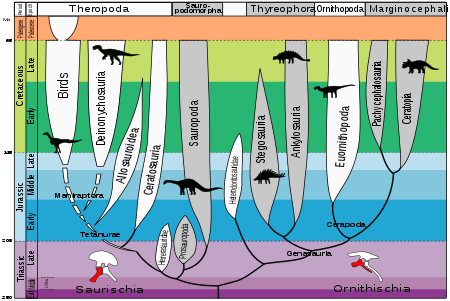
| Mounted skeletons of various dinosaurs, each from a different group. Clockwise from top-left are skeletons of: Tyrannosaurus, a predatory theropod; Diplodocus, a large sauropod; Parasaurolophus, a duck-billed ornithopod; Deinonychus, a bird-like dromaeosaurid; Protoceratops, an early ceratopsian; and Stegosaurus, a plated thyreophoran. | |
| ശാസ്ത്രീയ വർഗ്ഗീകരണം |
|
| Kingdom: | ജന്തു |
| Phylum: | കോർഡേറ്റ് |
| Branch: | Avemetatarsalia |
| Clade: | Dinosauriformes |
| Clade: | Dinosauria Owen, 1842 |
| Orders and suborders | |
|
|
വർഗ്ഗം , രൂപം , ആകൃതി ,ജീവിച്ചിരുന്ന പരിതഃസ്ഥിതി എല്ലാം കൊണ്ടും വ്യതസ്തമായ ജീവികൾ ആയിരുന്നു ദിനോസറുകൾ. ഫോസ്സിൽ തെളിവുകളുടെ അടിസ്ഥാനത്തിൽ പാലിയെന്റോളോജിസ്റ്റ്മാർ ഇവയെ അഞ്ഞൂറിൽ പരം ജെനുസുകൾ ആയും ,[2] ആയിരത്തിൽ പരം ഉപവർഗ്ഗം ആയും തിരിച്ചിട്ടുണ്ട്. എല്ലാ വൻകരകളിൽ നിന്നും ദിനോസറുകളുടെ ഫോസ്സിൽ കിട്ടിയിടുണ്ട്.
ഭീകരനായ പല്ലി എന്ന് അർഥം വരുന്ന ദിനോസർ എന്ന പേര് തെറ്റിധാരണ ഉണ്ടാക്കുന്നതാണ് കാരണം ദിനോസറുകൾ പല്ലികൾ അല്ല മറിച്ചു അവ ഉരഗങ്ങളുടെ ഒരു വ്യത്യസ്ത വർഗ്ഗം ആയിരുന്നു , ഉരഗങ്ങളിൽ കാണുന്ന സ്വാഭാവികമായ സവിശേഷങ്ങൾ പല ദിനോസറുകളിലും കാണാൻ സാധിക്കില്ല ,ഉരഗങ്ങളെ അപേക്ഷിച്ച് മിക്ക ദിനോസറുകൾക്കും നിവർന്നു നിൽകാൻ സാധിക്കുമായിരുന്നു. ഇത് കൂടാതെ പല പുരാതന ജീവികളെയും പ്രതേക്കിച്ച് മോസസോറുകൾ ,ഇക്തിയോസൗർ, ടെറാസോറസ്, പ്ലെസിയോസൗർ ,ഡൈമെട്രോഡോൺ എന്നിവയെയും ദിനോസറുകളായി തെറ്റിധരിച്ചിരുന്നു,
ഉള്ളടക്കം
|
പേരിനു പിന്നിൽ
ഇംഗ്ലീഷ് പാലിയെന്റോളോജിസ്റ്റായ റിച്ചാർഡ് ഒവൻ1840-ലാണു ഗ്രീക്ക് ഭാഷയിലെ ഭീകരനായ എന്നർത്ഥമുള്ള ദെയ്നോസ് എന്ന പദവും പല്ലി (ഉരഗം) എന്നർത്ഥമുള്ള സൗറോസ് എന്ന പദവും കൂട്ടിച്ചേർത്ത് ഡൈനസോർ എന്ന പേരുണ്ടാക്കിയത്.ചരിത്രം
ദിനോസാറുകൾ ആർക്കോസാറുകളിൽ നിന്നും ആവിർഭവിച്ചത് ഏകദേശം 230 ദശ ലക്ഷം വർഷങ്ങൾക്കു മുൻപേ മദ്ധ്യ-അന്തിമ ട്രയാസ്സിക് കാലഘട്ടത്തിൽ ആണ്. [3][4]. ഭുമിയിലെ 95% ജീവികളും നശിച്ച പെർമിയൻ-ട്രയാസ്സിക് വംശനാശത്തിനു ശേഷം ഏകദേശം 20 ദശ ലക്ഷം വർഷങ്ങൾ കഴിഞ്ഞാണ് ഇത്. റേഡിയോ പഴക്കനിർണ്ണയം വഴി മനസിലാക്കുന്നത് ഇയോറാപ്റ്റർ ഫോസ്സിലുകൾ ഈ കാലയളവിൽ നിന്നും ആണ് എന്നാണ്. പാലിയെന്റോളോജിസ്റ്റ്കൾ അനുമാനിക്കുനത് എല്ലാ ദിനോസറുക്കളുടെയും പൂർവികർ ഇയോറാപ്റ്റർകളെ പോലെ ആയിരിക്കും എന്നാണ് , ഇത് ശരിയാണെങ്കിൽ ആദ്യ ദിനോസറുകൾ ചെറിയ ഇരു കാലികൾ ആയ മാംസഭോജികൾ ആയിരുന്നിരിക്കണം.ട്രയാസ്സിക്, ജുറാസ്സിക്, കൃറ്റേഷ്യസ് എന്നീ മൂന്നു പ്രധാന കാലഘട്ടങ്ങളിലാണു ഡൈനസോറുകൾ നിലനിന്നിരുന്നത്.
ട്രയാസ്സിക് (25 കോടി വർഷം മുമ്പേ മുതൽ 20 കോടി വർഷം വരെ) ജുറാസ്സിക് (20 കോടി വർഷം മുമ്പേ മുതൽ 14.5 കോടി വർഷം വരെ) കൃറ്റേഷ്യസ് (14.5 കോടി വർഷം മുമ്പേ മുതൽ 6.5 കോടി വർഷം വരെ)
ഇവ നാമാവശേഷമായതിനെക്കുറിച്ചു പല സിദ്ധാന്തങ്ങളും നിലവിലുണ്ട് - ഉൽക്കകൾ പതിച്ചതുകൊണ്ടോ അഗ്നിപർവതസ്ഫോടനത്താലോ ഭൂമിയിലുണ്ടായ മാറ്റങ്ങളാണു ഡൈനസോറുകളുടെ നാശത്തിനു കാരണമെന്നാണു കരുതപ്പെടുന്നത്. ഇന്ന് ഭൂമിയിൽ കാണപ്പെടുന്ന പക്ഷികളുടെ മുൻ ഗാമികളാണു ഡൈനസോറുകൾ.
വലിപ്പം
രേഖപ്പെടുത്തിയതിൽവച്ച് ഏറ്റവും ഭാരമുള്ളതായി കണക്കാക്കപ്പെട്ടിട്ടുള്ളവ ആംഫിസെലിയസ് (122.4 ടൺ ), ആർജെന്റീനോസോറസ് (73 - 88 ടൺ ) എന്നിവയാണ്. ഏറ്റവും നീളം കൂടിയവ ആംഫിസെലിയസ് : 40 - 60 മീറ്റർ (131–198 ft), സൂപ്പർസോറസ് : 33 മീറ്റർ എന്നിവയുമാണ്. ഏറ്റവും ഭാരം കുറഞ്ഞവയിൽ ആഞ്ചിയോർനിസ് (110 ഗ്രാം ), എപിഡെക്സിപ്റ്റെറിക്സ് (164 ഗ്രാം ) എന്നിവയും ഏറ്റവും നീളം കുറഞ്ഞവയിൽ എപിഡെക്സിപ്റ്റെറിക്സ് 25 സെന്റിമീറ്റർ , ആഞ്ചിയോർനിസ് 34 സെന്റിമീറ്റർ എന്നിവയും ഉൾപ്പെടുന്നു.ഭക്ഷണം
ചില ഡൈനസോറുകൾ സസ്യഭോജികളും ചിലവ |മാംസഭോജികളും മറ്റു ചിലവ മിശ്രഭോജികളും ആയിരുന്നു.മാംസഭോജികളായ ചില ഡൈനസോറുകൾ
- റ്റി റക്സ് - റ്റിറാനോസാറസ് റക്സ്
- വെലോസിറാപ്റ്റർ
- സ്പൈനോസോറസ് - ഏറ്റവും വലിയ മാംസഭോജിയായ ഡൈനസോർ
- ജിഗാനോടോസോറസ്
സസ്യഭോജികളായ ചില ഡൈനസോറുകൾ
- ബ്രാക്കിയോസോറസ്
- ഡിപ്ലോഡൊക്കസ്
- ആർജെന്റീനോസോറസ്
- സൂപ്പർസോറസ്
- സ്റ്റെഗോസോറസ്
- ട്രൈസെറാടോപ്സ്
പറക്കുന്ന ഡൈനസോറുകൾ
സാംസ്ക്കാരികം
സർ ആർതർ കൊനാൻ ഡോയലിന്റെ 1912-ൽ പ്രസിദ്ധീകരിച്ച ദ് ലോസ്റ്റ് വേൾഡ്, മൈക്കൽ ക്രൈറ്റൺന്റെ 1990-ൽ പ്രസിദ്ധീകരിച്ച ജുറാസ്സിക് പാർക്ക് എന്നീ കൃതികളിലും ജുറാസ്സിക് പാർക്ക് (യൂണിവേഴ്സൽ സ്റ്റുഡിയോസ്), ഡൈനസോർ (ഡിസ്നി) എന്നീ സിനിമകളിലും ബാർണി തുടങ്ങിയ റ്റീവീ സീരിയലുകളിലും ഡൈനസോറുകൾ കഥാപാത്രങ്ങളാണ്.courtesy:ml
Subscribe to:
Comments (Atom)